Why does this blog post exist?
I was recently invited to speak at a panel about AI and cultural heritage. The main question was how to preserve cultural heritage in the age of AI. The event was covered by Vinkovačka televizija.
As I was thinking about this topic in preparation for the panel, I’ve realized that it’s not that straightforward. The main reason why is that cultural heritage is, by its very definition, in the past. That doesn’t mesh very well with AI (which is future-forward).
In this blog post, I present my ideas on how to preserve cultural heritage (to the maximum extent possible) in today’s AI world. Let’s begin.
What is cultural heritage and why should we care about preserving it?
First off, let’s define what cultural heritage is, in case someone is not clear on its definition. According to UNESCO: “Cultural heritage refers to the legacy of physical artifacts, traditions, and practices that are passed down through generations within a community. It encompasses both tangible elements, such as monuments and artworks, and intangible aspects like folklore and rituals.“
Now the more important question: Why should we care about preserving cultural heritage? I have to admit that I didn’t give much thought about cultural heritage prior to being invited to speak at this panel. However, as I’ve thought about it, I think a useful frame of reference is the following: Imagine you are slowly losing a percentage of your family pictures. You’re not losing it all at once, but rather as you want to view pictures you took on Christmas 15 years ago the file is corrupt and you can’t open it.
The same analogy applies to cultural heritage. As older people die (as morbid as that sounds), a piece of cultural heritage dies with them. Slowly but surely, every year we are losing more and more of cultural heritage. The fact that old(er) people tend to be technology-averse doesn’t help; when they die, their cookbooks, family images and other related material is usually put in a box somewhere, where it sits unused and is subject to physical deterioration over time.
So that’s the reason why we should care about it: because if at one point in time we decide we want to know “What is the traditional recipe for kulen?” or “How do we knit a traditional folk costume?”, we may not have the answer as that part of cultural heritage has faded away. If you didn’t know, “kulen” is a traditional, highly prized flavored cured pork sausage from Slavonia (part of Croatia where I’m from).
Now that we’ve established why we should care, let’s try to enumerate all the ways we can lose cultural heritage, because it helps us see if there’s any way to mitigate cultural heritage loss (if any).
In what ways can we lose cultural heritage?
When I was thinking about this problem, I tried to think of all the ways cultural heritage can be lost. I’ve identified 3 main ways; maybe there’s more, but these 3 cover a lot of ground.
Death
When old people die, a part of cultural heritage is lost with them. No matter how much effort that person spent passing their cultural heritage knowledge onto others, a part of it will be irrecoverably lost.
However, one way to mitigate the loss is to record the person talking about something cultural heritage related – could be a video about cooking some traditional food or making some traditional clothing. Afterwards, store that video and its transcript in a digital format, so that it’s accessible even after the person dies. In this way, we maximize cultural heritage preservation by digitization.
Deterioration of physical material
I think most of us have some version of grandma’s cookbook which has yellow pages whose edges turned brown. It will likely be OK for a while, but after certain amount of time passes that writing will become unintelligible.
Therefore, deterioration of physical material is one way we can lose cultural heritage, but we can fight this off by digitizing the material – converting the cookbooks to digital text documents, converting physical images into digital images etc.
Having to invest a lot of effort to retrieve cultural heritage material
This way to lose cultural heritage is more subtle than the first two, so I’ll try to explain it by example.
Say I want to cook a traditional Slavonian stew called “ćobanac”. Also, assume that this is the first time that I’m cooking it.
How would I do that? Well, I would probably:
- Call someone I know (usually family) to provide me a recipe and tips for cooking ćobanac
- Proceed to cook
But now imagine that I have no one available to call. What now? If I wanted to cook traditional ćobanac, I’d have to do something like this:
- Search for a traditional ćobanac recipe, either by locating an old cookbook somewhere in the house (if I have it) or going to the local library to search for a local cookbook
- Proceed to cook
The procedure above is a nuisance because I can easily spend a few hours on step 1 – trying to locate a cookbook somewhere in my house or going to the local library. That requires a time investment I may not have.
Instead, what I’d most realistically do (if my family wasn’t available):
- Ask ChatGPT (or some other LLM, but let’s call it ChatGPT for simplicity) to give me the recipe for a traditional Slavonian ćobanac
- Proceed to cook
Here’s the kicker, however: ChatGPT might not give me the recipe for a traditional Slavonian ćobanac – it might:
- Hallucinate (make the recipe up)
- Tell me that it does not know the recipe for Slavonian ćobanac exactly or
- Produce a generic recipe based on its prior knowledge (from its training data)
- This one is the worst type of failure, as it is very hard to detect for someone not familiar with the traditional recipe
Now, let’s think about this for a bit: in case my family is unavailable (for any reason), I am looking at either spending a significant portion of my time to find the original traditional Slavonian ćobanac recipe (in case it’s not readily available) or I can ask ChatGPT and it provides an answer in under a minute. Since I (as I assume most other people) prefer convenience, I’d opt for the latter. Also, ChatGPT is capable of answering some follow-up questions pertaining to the recipe that I will likely have, while a cookbook can’t do that.
However, as we discussed, ChatGPT can give me inaccurate information. This can be fixed by having the traditional Slavonian ćobanac recipe in a digital, AI-friendly format on the internet. In that case, when ChatGPT searches the internet (and it has the capability to do so), it has the possibility to find the exact recipe I am looking for. Note that I said “has the possibility”; there’s no guarantee ChatGPT will find the materials we posted online, as this also depends on page reputation and other factors, but at least now the information lives in the digital space and can be retrieved.
So the risk here isn’t that we will lose cultural heritage abruptly or slowly-but-surely; it’s rather that we will lose the specifics of certain cultural heritage materials (such as recipes). By digitizing our cultural heritage (in an AI-friendly format), we prevent this as well.
How to digitize data so that it’s AI-friendly
One thing I wanted to clarify is: What does it mean that the data is AI-friendly? In short, this would mean that:
- It lives as plain HTML text on a stable domain
- OCR/transcription is used instead of scanned images
- It’s openly licensed (CC BY or CC BY-SA, for example)
- It contains AI-friendly markup (such as schema.org)
- It’s crawlable
For example, for our ćobanac recipe, we could use the Recipe type from schema.org, which would later allow AI to easily parse it. In short, AIs love well-structured text and we should give it to them.
How to prevent cultural heritage loss (to the maximum extent possible)
As we’ve seen so far, there are 3 principal ways to lose cultural heritage:
- Death
- Deterioration of physical material
- Having to invest a lot of effort to retrieve cultural heritage material
All of these can be mitigated, as we’ve discussed, by digitizing materials pertaining to cultural heritage (such as recipes, how-to guides etc.).
So, the answer to our question:
How to prevent cultural heritage loss?
is
By digitizing cultural heritage material.
In this way, we prevent cultural heritage loss to the maximum extent that we can. Not only that, but by allowing AI to have access to digital cultural heritage materials, we augment it, so we can ask questions (and follow-up questions) to AI and have it explain things that we found unclear. It may not always give us the most accurate answer, but other than speaking to a living human it is likely the next best thing.
Conclusion
In summary, to preserve cultural heritage, we should embrace digitization (and AI as a part of it), instead of resisting it. In this way, we not only preserve materials which would otherwise be destroyed or deteriorate, but we also make the materials accessible to information retrieval technologies (such as search engines and AI).
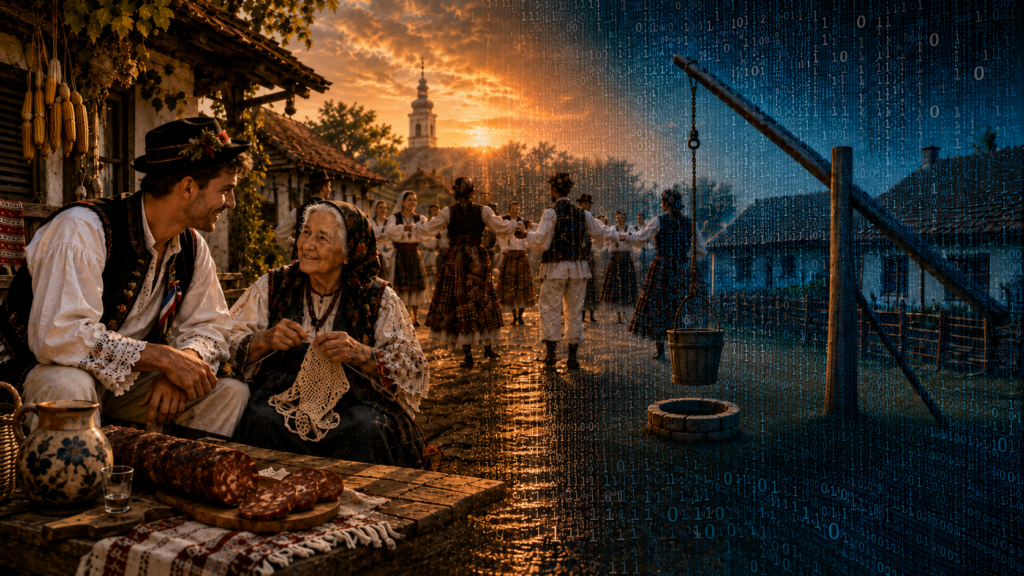
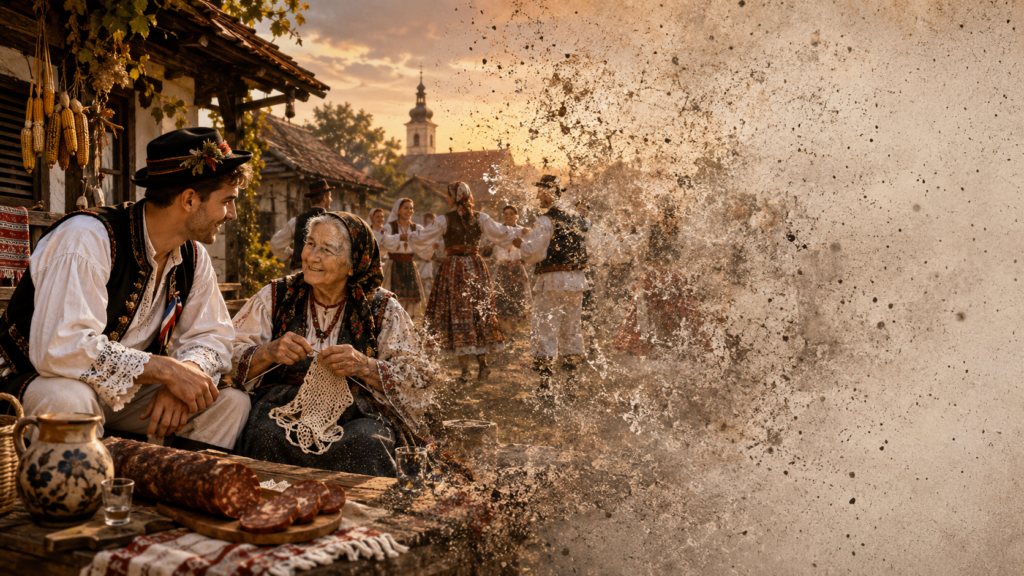
While we won’t be able to perfectly preserve cultural heritage, we can at least do our best. If we do, the faded half of the image at the top of this post doesn’t have to stay empty; it can be filled back in: